Security as an afterthought is the expensive option
The rise in breaches across every industry says the same thing: security bolted on at the end of software development no longer holds. IBM's 2023 Cost of a Data Breach study put the average breach at USD 4.45 million, found that 82 per cent of breaches involved data held in the cloud, and recorded a 41 per cent rise in ransomware attacks in a single year. Behind those numbers sit familiar failures: a compromised third-party component, an API that served data it should never have exposed, a cloud store left open by a misconfiguration, a zero-day nobody had planned for.
Each of those is cheaper to prevent in a design review than to discover in a penetration test, and cheaper in a penetration test than in an incident. That arithmetic is the whole case for secure by design.
Security is a business requirement, not a technical checkpoint.
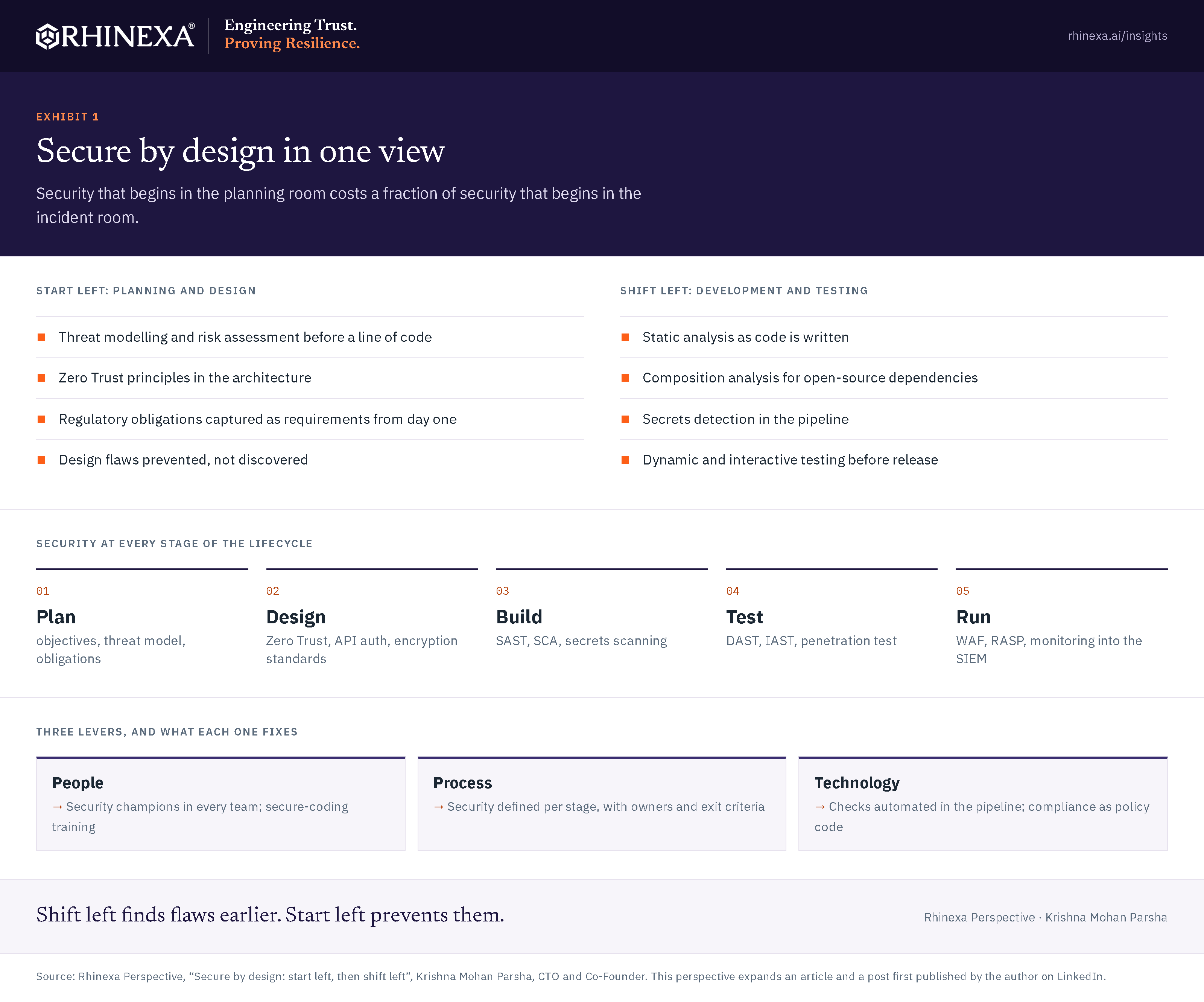
Secure by design in one view
Security that begins in the planning room costs a fraction of security that begins in the incident room.
- Threat modelling and risk assessment before a line of code
- Zero Trust principles in the architecture
- Regulatory obligations captured as requirements from day one
- Design flaws prevented, not discovered
- Static analysis as code is written
- Composition analysis for open-source dependencies
- Secrets detection in the pipeline
- Dynamic and interactive testing before release
Start left, then shift left
Secure by design makes security an integral part of architecture, development and deployment, so that vulnerabilities are eliminated at the earliest stage rather than found in testing or after release. It rests on two disciplines that are often used interchangeably and should not be.
Start left: security in planning and designThreat modelling and risk assessment before development begins; Zero Trust principles in the architecture; regulatory obligations, whether PCI DSS, HIPAA, GDPR or India's DPDP Act, treated as requirements from day one. Start left prevents the design flaws that later become systemic vulnerabilities.
Shift left: security testing in developmentStatic application security testing as code is written; software composition analysis for open-source dependencies; secrets detection in the pipeline. Shift left finds flaws at the developer's desk, where they are cheapest to fix.
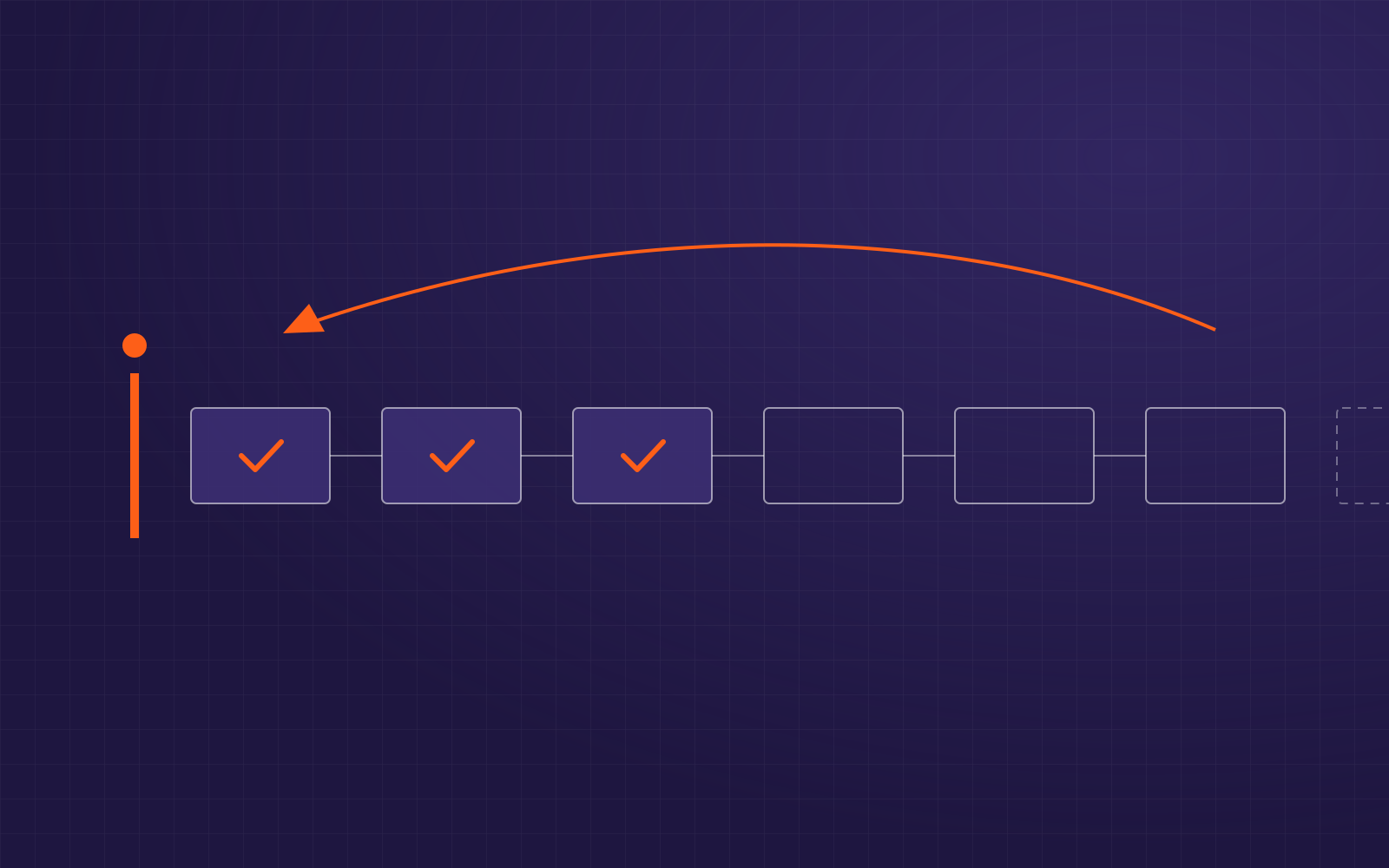
Shift left finds flaws earlier. Start left prevents them.
Security at every stage of the lifecycle
Planning and requirements (start left)Define security objectives and risk factors from the business need. Threat model the attack vectors. Capture compliance obligations as requirements. Frameworks: OWASP threat modelling, the NIST Cybersecurity Framework, ISO/IEC 27001.
Design and architecture (start left)Zero Trust and data protection in the design. OAuth, JWT and OpenID Connect for API authentication. Encryption standards fixed up front: AES-256 at rest, TLS 1.3 in transit. OWASP SAMM for governance.
Development (shift left)SAST and SCA in the CI/CD pipeline, secure-coding guidelines enforced, secrets scanning on every commit.
Testing (shift left)DAST and IAST for runtime flaws, penetration testing before release, verified against OWASP ASVS for web and MASVS for mobile.
Deployment and runtimeAutomated checks in the pipeline, a web application firewall and runtime protection in front of production, and telemetry into the SIEM. The OWASP DevSecOps Verification Standard sets the baseline.
People, process, technology
Frameworks fail where the organisation does not change with them. Three patterns recur in the programmes we are asked to rescue.
PeopleDevelopers with little security awareness, security teams working in silos, compliance treated as a checkbox. The fix: secure-coding training built on the OWASP Top 10 and CWE/SANS Top 25, security champions inside each development team, and continuous awareness through capture-the-flag and gamified learning.
ProcessSecurity as a one-time event, flaws found too late, compliance unenforced between audits. The fix: security activities defined for every stage, each with an owner and an exit criterion.
TechnologySecurity slows delivery when it is manual, and developers get no real-time feedback. The fix: SAST, DAST and infrastructure-as-code scanning automated in the pipeline, compliance expressed as policy code, anomaly detection through the SIEM.
What to automate first
- Static analysis and composition analysis on every commit.
- Secrets detection in the pipeline, so credentials never reach a repository.
- Infrastructure-as-code scanning against CIS Benchmarks.
- Dynamic testing in staging, before every release.
- Compliance policies as code, with the evidence collected automatically.
The aim is not to slow delivery with gates. It is to make the secure path the fast path.
Where to begin
Pick one product team, not the whole estate. Run a threat model on their next feature. Put static and composition analysis into their pipeline. Appoint a champion. Measure time-to-fix before and after. Then expand, team by team, with the numbers in hand.
Secure software development is no longer optional. It is a business imperative.

Krishna works at the intersection of cyber security, infrastructure, AI and enterprise risk, with a focus on engineering trustworthy and resilient technology foundations.
Follow on LinkedInThis perspective expands an article and a post first published by the author on LinkedIn.