
AI use and exposure assessment
Which AI services and agents are in use, by whom, and with what kind of data, including regulated Indian identifiers.
No suggestions match. Press Enter to search the whole site.

Adopt AI with policy, assurance and evidence. We help enterprises see where AI is used, decide what it may do with which data, govern the agents that act, and prove it to a regulator.
Staff paste customer data into assistants, developers connect coding agents to repositories and pipelines, and business units adopt AI features inside the SaaS they already use. Each is useful. Each also creates a non-human actor with access, context and, increasingly, the authority to act.
Banning is not a strategy. Governed adoption is: knowing what is in use, bounding it with identity and policy, authorising sensitive actions before they execute, and keeping evidence that stands up to review.
Take one offering on its own, or combine them into a programme with a named lead and agreed exit criteria.
Which AI services and agents are in use, by whom, and with what kind of data, including regulated Indian identifiers.
Roles, acceptable use, data boundaries and approval paths, mapped to the DPDP Act and sector expectations. Mapping supports assurance; it is not certification.
Retrieval, memory, model access and data boundaries reviewed before an AI system reaches production.
Identity for agents, per-action policy and signed evidence, delivered with Rhinexa Niyantran where enforcement is required.
Prompt injection, data leakage and tool-abuse testing of assistants, agents and the systems around them.
Policies, pipeline controls and developer guidance so engineering teams keep the productivity without losing the source code.
A named practice lead from scoping to close, with deliverables agreed before work starts.
Establish where AI operates, who uses it and what data it can reach.
Define data, tool, purpose and autonomy boundaries, and who owns each.
Put policy at the moment of action for the systems that can act.
Retain evidence that supports assurance, audit and incident reconstruction.
Measured outcomes from real engagements will be published here once clients consent.
An inventory of services, agents and data classes, kept current.
Regulated data protected and sensitive actions authorised, not assumed.
Signed, hash-linked records that can be verified offline.
Identity-based policy, regulated-data protection and signed evidence of every decision, deployed where your data lives.
Explore Rhinexa Niyantran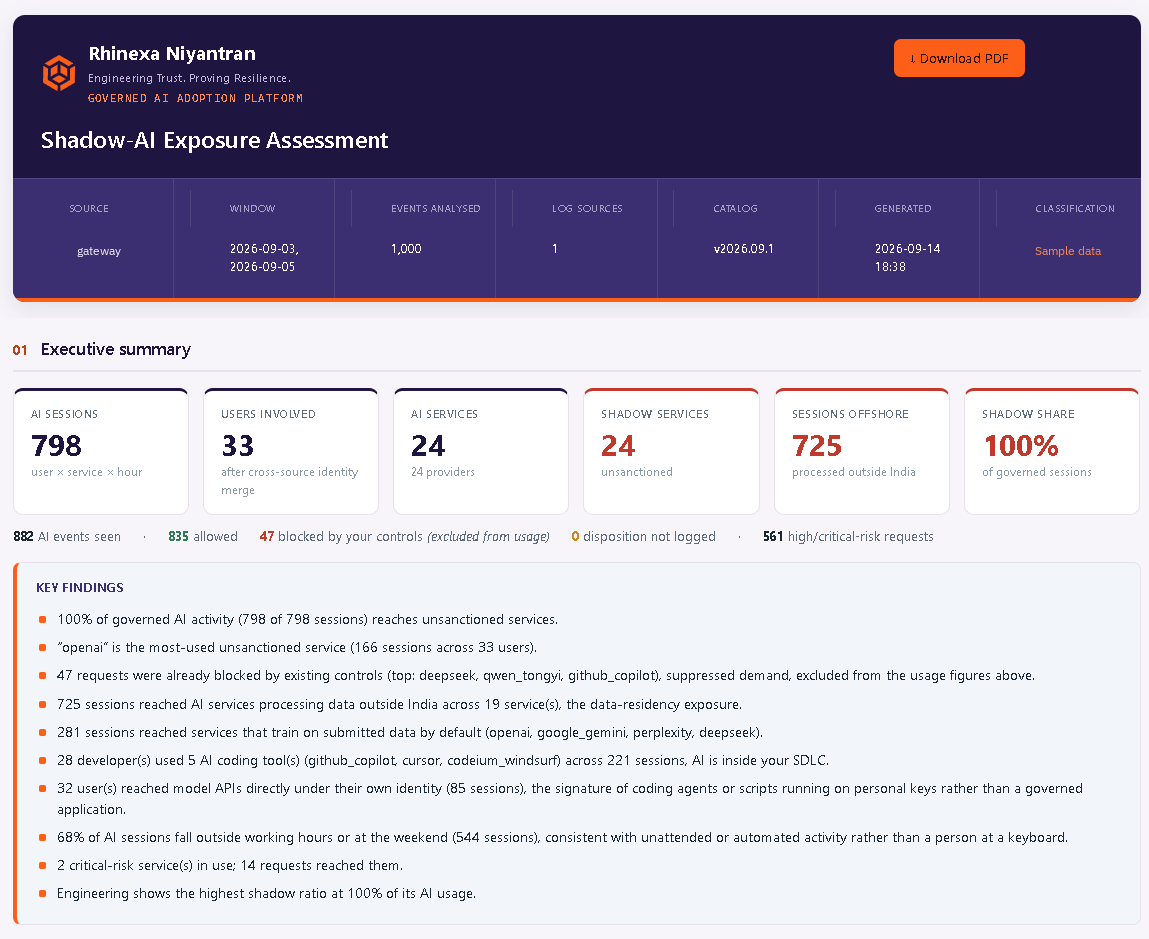 Sample data
Enterprise AI is moving from answering questions to taking actions. The security model has to follow.
Read the perspectiveTell us what you are working on and a practice lead will respond.
Contact the practice