
Shadow AI
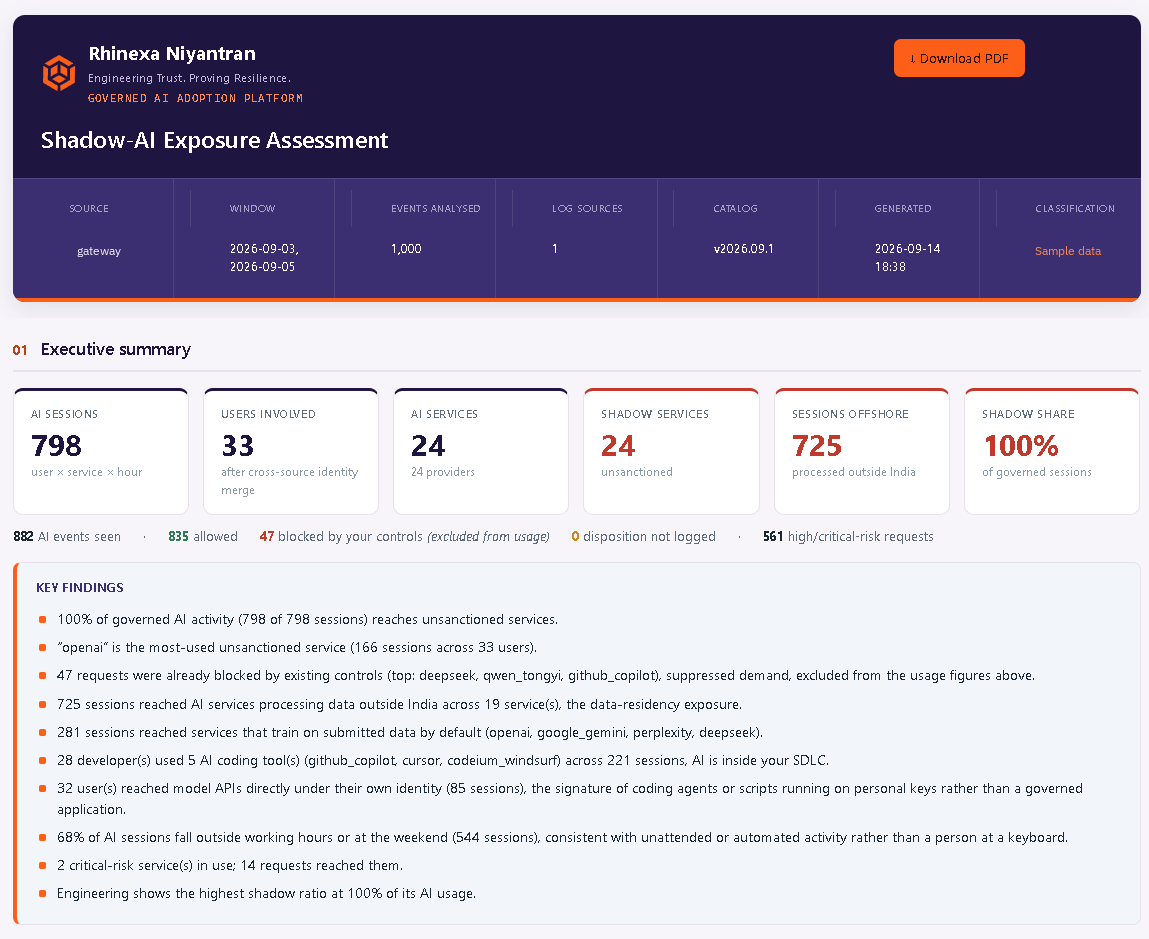
Teams adopt assistants and agents outside approved channels. Prompts, context and actions leave the visibility of security and GRC.
No suggestions match. Press Enter to search the whole site.

One governed front door for enterprise AI. Identity, policy, data protection and action control are applied before a request reaches an approved model, and every decision leaves signed evidence behind. Deployed in your environment.
 Sample data
Adopting AI without a control point leaves security, privacy and compliance teams reacting after the fact.
Teams adopt assistants and agents outside approved channels. Prompts, context and actions leave the visibility of security and GRC.
Sensitive payloads can reach models and regions that conflict with the DPDP Act, sectoral rules and contractual residency obligations.
Coding agents and desktop tools execute tool calls and endpoint actions with no identity, policy or evidence of what was allowed.
Niyantran binds identity, policy, data protection and endpoint action into a single decision path.
Approved coding agents and AI tools are routed through one governed entry point, so policy is consistent whatever the channel or IDE. Per-action enforcement is live for Claude Code and Codex; other tools are governed for prompts and data.
Decisions follow who is acting: analyst or developer, restricted or elevated estate, with persona rules that travel with the session and a policy floor no user can override.
Sensitive data is detected and masked before it leaves: Indian identifiers such as Aadhaar, PAN, GSTIN, UPI, IFSC and ABHA, and secrets. The workflow continues under policy.
Govern what an agent may do at the endpoint, not only what it may say: each action allowed, masked or denied by policy. Live today for Claude Code and Codex.
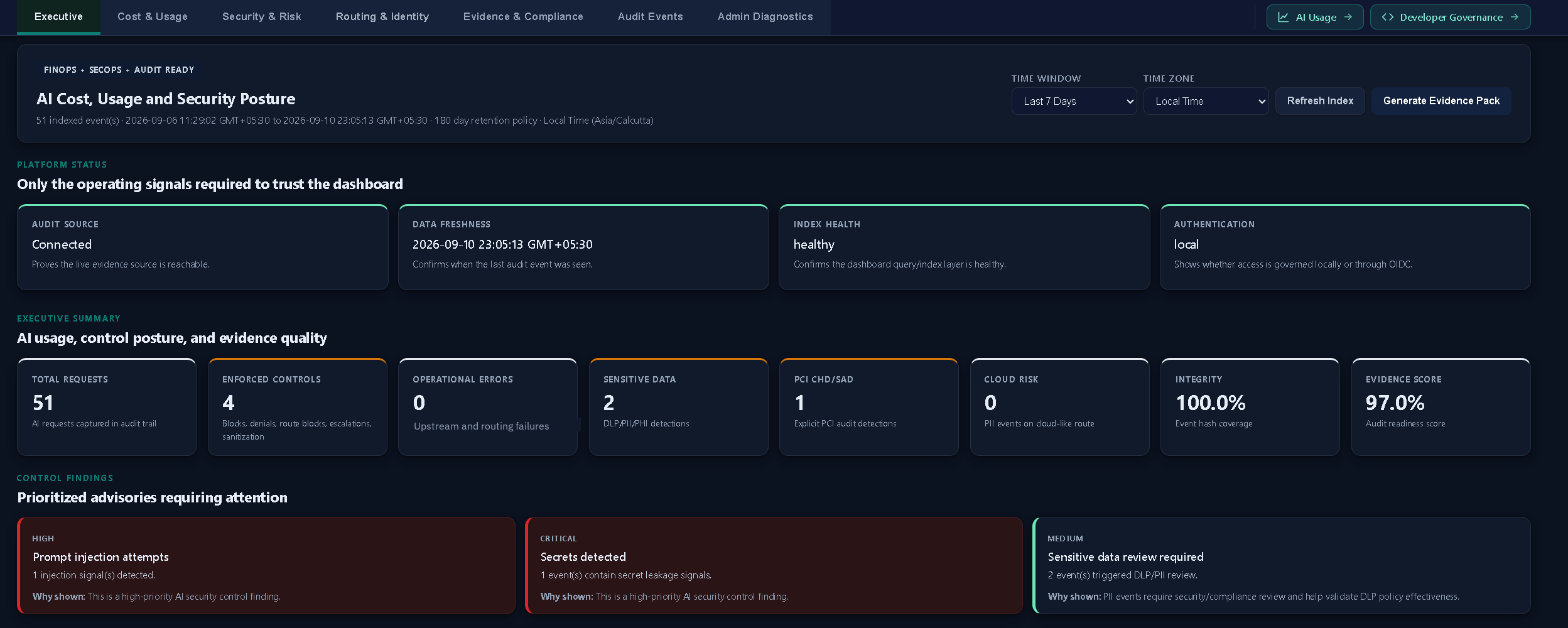
Six steps on every request, in one path, without handing you off to another tool.
Who is acting: user, role, department and risk tier, resolved from your identity provider.
Policy evaluates the request against identity, data class and destination: allow, mask or deny.
Sensitive data is masked or redacted before egress; prompt injection and secrets are detected.
Approved work goes to the right model: local for regulated data, cloud for approved tasks, by policy.
Agent actions at the endpoint are checked per action on managed surfaces, with egress control on managed Windows endpoints.
Every decision becomes a signed, hash-linked record in the audit console, exportable as evidence.
 Sample data
Every capability below is part of one path: protection, routing, defence and evidence connected.
Also included
We publish exactly what each capability covers now and what is on the roadmap, so you can plan a pilot on facts.
| Surface | Prompt and data governance | Per-action enforcement |
|---|---|---|
| Claude Code | Live | Live |
| Codex | Live | Live |
| Other supported AI tools such as Cursor and Cline | Live | Roadmap |
| Managed Windows endpoints | Egress control: no AI egress to catalogued destinations Live | |
| Unmanaged agents | Discovered and contained at the network. No per-action control is claimed. | |
Managed agents are enforced per action. Unmanaged agents are discovered and contained at the network. We do not claim per-action control of an agent we are not installed in.
The same platform covers a single segment or a distributed estate.
Govern Claude Code and Codex today, and other approved tools for prompts and data, through one door with one policy.
Keep sensitive prompts and payloads under the DPDP Act and sectoral obligations with masking, residency-aware routing and exportable evidence.
See unapproved assistants and agent paths before they become blind spots, and contain them on managed endpoints.
One operating view for both teams: decisions, policy outcomes and signed records in one rhythm.
Deploy on-premises or air-gapped so governed AI stays inside your control boundary without rewriting client tools.
Start in observe mode, prove the evidence, then enforce: from visibility to containment without lock-in.
One control point you host: identity, policy, protection and signed records inside your boundary, ready for the obligations your teams already report against.
Policy outcomes are logged, timestamped, attributed and exportable for security and compliance.
On-premises, private cloud or air-gapped. Nothing in the decision path needs a public service.
Evidence collection supports the DPDP Act and the CERT-In, RBI and SEBI reporting contexts your teams already use.
Aligned to the evidence needs of ISO/IEC 27001, SOC 2, NIST AI RMF and the OWASP Top 10 for LLM applications. Mapping is not certification.
Observe safely, then enforce; fail closed only on the segments you agree.
Niyantran helps you collect evidence against obligations. It does not claim certifications you have not earned.
Two weeks to mobilise, six weeks to run. Acceptance criteria are agreed in writing before anything is installed: observe first, enforce when ready, contain where the residual risk demands it.
Scope, success criteria, users and data classes agreed; platform deployed in your environment.
Monitor mode establishes a baseline of real AI use: prompts, data classes, destinations and would-be decisions.
Policies switched on for agreed groups and surfaces; egress control and action guard where agreed.
Results measured against the acceptance criteria, with the signed evidence to show it. No lock-in.
A guided demo, then an eight-week pilot with acceptance criteria agreed up front.
Request a Rhinexa Niyantran pilotOur AI Security practice advises on governance, architecture and assurance for AI adoption.
Talk to a specialist